ZippyScore
ZippyScore is a proprietary rating based on 6 criteria: performance, portability, display, battery, value, and connectivity.
See rating criteria
- Performance: CPU / GPU performance
- Portability: Screen size & weight
- Display: Panel type, aspect ratio & refresh rate
- Battery: Rated battery life
- Value: Specs-to-price balance
- Connectivity: Port types & count
Pros & Cons
Pros
- 16GB of memory keeps things moving when you've got a pile of apps open at once
- USB-A, HDMI and a LAN port all on board, so you're not hunting for adapters
- Face and fingerprint unlock both built in, so logging in is quick
- Wi-Fi 6E support keeps calls and everyday work on a stable connection
Cons
- At 1,477 g measured it's a bit heavy for a 14-inch → worth a look at lighter models if you carry one all day
- No keyboard backlight → barely an issue in a well-lit office
- Not much muscle for heavy or demanding workloads → plenty if your day is mostly admin
Specs Summary
| OS | Windows 11 Pro |
|---|---|
| CPU | AMD Ryzen AI 5 430 (PassMark: 13,437) |
| RAM | 16GB |
| Storage | 512GB |
| Display | 14" IPS (Anti-glare) 1920x1200 (16:10) |
| Weight | 1.54 kg (3.40 lbs) |
| Ports | USB-C × 2 (10Gbps/PD/Video out), USB-A × 2 (5Gbps), HDMI × 1 (ver.2.1), Ethernet (RJ-45) × 1, Headphone jack × 1 |
| GPU | AMD Radeon 840M (G3D Mark: 3,805) |
| Biometrics | Fingerprint |
| Battery | Up to 7.5 h (Capacity: 56 Wh) |
| Camera | 5.0 MP |
| Dimensions | Approx. 318.60 × 224.30 × 20.40 mm (W × D × H) |
| Wi-Fi | Wi-Fi 6E |
| Bluetooth | Bluetooth 5.3 |
| Color | Pike silver |
Configurations vary by retailer, region, and availability.
Hands-on Review
Right, here's how the ProBook 4 G2a 14 AI PC got on. This is the configuration I had on the desk:
| Item | Review unit |
|---|---|
| CPU | AMD Ryzen AI 5 430 |
| Memory | 16GB |
| Storage | 512GB SSD |
| Display | 14-inch (1920x1200) |
| Graphics | AMD Radeon Graphics |
Configurations can vary depending on when and where you buy.
Design
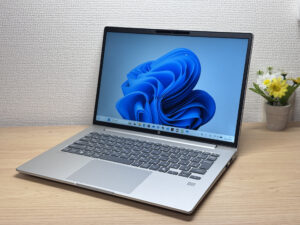
Starting with the design. The colour is a restrained silver that looks entirely at home on an office desk — textbook business styling, with none of the attitude you'd get from a creator machine. It's deliberately uniform, the sort of thing that slots into a mass rollout without anyone raising an eyebrow. The finish resists fingerprints, so it still looks tidy after a day of carrying it about and prodding at it, which is a small thing but genuinely welcome.
 Classic silver styling that disappears into any office — this is what a business laptop looks like!
 The finish keeps fingerprints at bay, so it never feels grubby to the touch
It isn't ultra-thin by 14-inch standards, but it never reads as chunky either — the balance is judged nicely. It slides into a bag without any wrestling, and you get the sense someone thought about that.
 Not too thin, not too chunky — it slips straight into a bag!
The HP logo on the lid gets a mirror finish, and that little bit of gloss is what sharpens the whole thing up. On consumer laptops a logo can end up shouting at you, but this one stays understated and looks rather smart for it — very much a business machine trait.
 The mirror-finish HP logo tightens up the whole lid!
 Just enough gloss to look smart without shouting!
The underside keeps visible screws to a minimum too, which I liked. The rubber feet run along the top and bottom edges and hold the machine in place, so it doesn't shuffle about while you type.
 Few visible screws & grippy rubber feet — it stays put!
On opening the lid: the base does lift off the desk a little as you go (the 16-inch model I reviewed a while back did the same). That said, the notch gives your finger something solid to catch, so with one hand steadying the chassis it swings open easily enough. In practice it's a non-issue.
 The notch catches nicely, so it opens with one hand!
 Steady the base and the hinge feels reassuringly solid!
The lid goes back a full 180 degrees, the usual business-laptop arrangement, so you can flip it round to show someone in a meeting — though of course they're then looking at everything upside down, which rather limits how useful it is.
 A full 180 degrees flat — handy in meetings (in theory)!
Portability
Next, portability. On my scales it came in at 1,477 g (roughly 3.3 lbs). Having put a fair number of 14-inch laptops through this, I'd say that's on the heavy side for the class. Once you're into the high 1.4 kg range, I do start wishing someone had pushed a bit harder on the weight.
 1,477 g measured — a bit heavy for a 14-inch…
The charger, on the other hand, is remarkably light at 162.5 g. It's a compact 65W USB-C brick with folding mains pins, and it weighs about the same as the small third-party USB-C chargers I normally carry, which counts for a lot. The laptop may be on the heavy side, but the featherweight charger claws back a good chunk of what you're actually carrying.
 162.5 g measured — as light as a compact USB-C brick, which surprised me!
 Folding pins keep it compact — it won't hog space in your bag!
Held in one hand, that 1,477 g does make itself known after a moment. Still, it sits within normal territory for a 14-inch machine, and for everyday carrying it's perfectly manageable.
 A bit of heft one-handed, but nothing out of the ordinary!
Display quality
On to the display. It's a 1920x1200 IPS panel, and colour reproduction is good in a standard-for-IPS sort of way. You're not getting the inky blacks of an OLED, but for office work the colour on offer is more than enough, and I came away happy with it.
 Colours come through vividly — bright photos really land!
 Fruit tones look natural — honest, IPS-style colour!
 Far more colour than office work asks for!
Viewing angles are excellent — shift off to the side and the colours barely move. If a few of you are peering at the same screen in a meeting, you're not going to be fighting colour shift, which matters more than it sounds.
 No colour wash-out off-axis — fine for a huddle round the screen!
The aspect ratio is 16:10, and next to a 16:9 panel the extra vertical space is obvious at a glance. Open the same web page and you scroll less and reach for the mouse less, so your working pace just quietly picks up. That's a real draw.
 The extra height of 16:10 is obvious — less scrolling, less faff!
It's a matte panel too, so reflections stay low. Offices tend to be lit by rows of strip lights, and not having that glare bouncing back at you makes a long day at the desk noticeably easier on the eyes.
 Matte finish keeps reflections down — kinder on the eyes over a long day!
Keyboard and typing
Next, the keyboard. The layout on this unit is a properly worked-out Japanese one, with nothing crammed together and everything sitting where it should.
 A tidy Japanese layout with no awkwardly squeezed keys!
The missing keyboard backlight is a genuine mark against it, though. Working in a dim room isn't really on the cards — but offices are usually lit up like operating theatres, so day to day it may never come up. Read it as a place where cost was trimmed and it makes sense.
 No backlight, so visibility in the dark is poor…
The typing action itself is plain and unfussy. The keycaps feel a touch plasticky, but the chassis underneath is rigid enough that everything stays planted. Combined with the clean layout, it's an easy machine to type on.
 A rigid chassis means typing feels stable!
 A simple action, and the tidy layout makes it easy to get words down!
Quick heads-up: these photos are the Japan-market unit, so the keyboard shown is the Japanese layout. UK models ship with the standard UK (ISO) layout.
Trackpad
Next, the trackpad. It's noticeably large relative to the keyboard area, and everyday pointing is easy as a result. At this size you can work comfortably with it on your lap on the train without carrying a mouse, which is a nice bonus.
 Big enough to use comfortably on your lap!
Gestures register properly too, and the whole thing feels closer to a MacBook than most. It's standard Windows functionality, but the extra surface area makes it pleasant to actually use.
 Close to MacBook feel — gestures respond smoothly!
Performance
On to the CPU and general performance. PCMark 10 returned 5,148, which I'd call a slightly underwhelming result.
 PCMark 10 scored 5,148 — I'd have liked a bit more!
| Total Score | Rating | What it feels like in real use |
|---|---|---|
| ~4,000 | Bare minimum | Web browsing and simple tasks work, but multitasking or many tabs feels sluggish. |
| 4,000–5,000 | Light use | Daily tasks are doable, but running multiple apps means waiting around. |
| 5,000–6,500 | Comfortable (mainstream) This PC | Handles most work without stress — fine for office, school, video calls. |
| 6,500–8,000 | High performance | Plenty of headroom. Light photo editing and programming feel snappy. |
| 8,000+ | Very high performance | Tackles video editing and heavy workloads. Long-lasting performance. |
*PCMark 10 reflects overall comfort. Actual feel depends on CPU, RAM, and SSD speed.
The unit I was lent runs a Ryzen AI 5 430 rather than a Ryzen AI 7, so it's fine for ordinary office work but not the machine for anything heavy. Judged as a business laptop doing business-laptop things, though, there's nothing to complain about. Cinebench 2026 came back with 1,058 pts multi-core, another middle-of-the-road figure that's perfectly comfortable for day-to-day admin.
 1,058 pts multi-core in Cinebench 2026 — plenty for office work!
| Score | Rating | What it feels like in real use |
|---|---|---|
| Up to 1,000 | Bare minimum | Light tasks work, but heavier processing or multitasking feels constrained. |
| 1,000–2,000 | Standard (power-efficient) This PC | Handles daily tasks, but heavier loads create waiting. |
| 2,000–3,000 | Comfortable (mainstream) | Office, school, video calls all work comfortably. Plenty for most users. |
| 3,000–4,000 | High performance | Comfortable for multitasking, light/medium editing, and dev work. |
| 4,000+ | Very high performance | Handles video editing and heavy workloads with room to spare. |
*Cinebench 2026 is the latest CPU multi-core benchmark. Scores trend lower than R23, so direct comparison isn't valid.
On the graphics side, 3DMark Steel Nomad Light managed 1,076, which is on the modest end. I can't imagine anyone gaming on this, but as a measure of video encoding and general on-screen rendering it's about par.
 1,076 in 3DMark — a score for everyday visuals rather than gaming!
| Score | Rating | What it feels like in real use |
|---|---|---|
| Up to 400 | Bare minimum | 3D performance is quite limited. Not really suited for gaming. |
| 400–900 | Light 3D | Lighter games and low-load 3D processing work. |
| 900–1,500 | Average (mainstream) This PC | Standard for integrated GPUs. Light to medium games playable with right settings. |
| 1,500–2,200 | High performance | Strong for an integrated GPU. Games and 3D work feel comfortable. |
| 2,200+ | Very high performance | Top-tier 3D performance for thin laptops. Real graphics headroom. |
*3DMark Steel Nomad Light targets thin laptops and integrated GPUs. Score range differs from Time Spy, so direct comparison isn't valid.
The one figure that gave me pause was storage speed in CrystalDiskMark: 1,990 MB/s read and 2,485 MB/s write. That's a little behind recent releases, though set against the 500-600 MB/s of a hard drive it's still quick, and nothing you'd notice in normal use.
 1,990 MB/s read, 2,485 MB/s write — a shade behind the latest machines…
| Score | Rating | What it feels like in real use |
|---|---|---|
| Up to 600 MB/s | Bare minimum | Faster than HDD, but slow for modern SSDs. App launches feel slightly slow. |
| 600–1,500 MB/s | Average | Fine for daily use, though loading is noticeably slower than top-tier SSDs. |
| 1,500–3,500 MB/s | Comfortable (mainstream) This PC | App launches and file loading feel smooth. No real complaints in daily use. |
| 3,500–5,500 MB/s | Fast | Loads large data and apps quickly. Definitely upper-tier SSD speed. |
| 5,500+ MB/s | Very fast | High-end NVMe territory. Heavy data work without waiting. |
*CrystalDiskMark measures SSD speed. It mainly affects app launch and file loading speed, not overall PC performance.
Battery life
Next, battery life.
Battery rating: average
The battery is 56Wh, and with a 14-inch screen to feed, power draw never gets out of hand. A few hours at an office desk without the charger looks comfortably doable. For a long day out of the office, though, I'd throw the charger in the bag to be safe.
 Checking battery health — capacity sits around the quoted 56Wh!
Fan noise and heat
Next up, fan noise and heat. At idle I measured 19.9 dB, near enough silent, and for light work the fans simply don't spin up.
 19.9 dB at idle — effectively silent, no distraction!
Load the CPU and it climbs to 38.6 dB, but it stops short of 40 dB, which suggests the cooling has been tuned with some care. It behaved the same way as the 16-inch model did on the bench, and you can tell this is a machine built to business standards.
 38.6 dB under load — the cooling keeps it under the 40 dB mark!
| Noise Level | Rating | Feel |
|---|---|---|
| Under 30 dB | Near-silent Idle | Fan noise is barely perceptible — library-quiet and ideal for focused work. |
| 30–35 dB | Quiet | Faintly audible but non-distracting. Easy to work in a quiet room. |
| 35–40 dB | Noticeable Load | You can tell the fan is spinning, but it rarely interrupts work. |
| 40–45 dB | Somewhat loud | Can become distracting in quiet environments. Headphones start to help. |
| 45–50 dB | Loud | Noticeable stress over extended use. Cooling is clearly prioritized. |
| 50 dB+ | Very loud | Prominent fan noise under load — gaming/high-performance thermal design. |
The exhaust vents out of the back, so even with a mouse beside it and your hands resting either side, you're unlikely to get warm air blowing over them.
 Rear-facing exhaust, so hot air stays away from your hands!
Ports and connectivity
Now the ports. The left side carries HDMI, USB-A, two USB-C and a headphone jack.
 A LAN port you plug straight into means no hub, and there's a Kensington lock for security!
The right side has a Kensington lock slot, a USB LAN port and USB-A. Being able to plug an ethernet cable straight in matters more than it sounds — you get a stable network connection without a USB-C hub in the way, which is exactly the sort of thing a business machine should do. The Kensington lock is reassuring on the theft front too. Plenty of laptops drop it these days, so having it here counts for something.
 The left side has USB-A, two USB-C and a headphone jack — a sensible spread!
HDMI comes as standard as well, so you can walk into a meeting room, plug one cable in and get your screen up.
 HDMI built in — one cable and you're on the meeting room screen!
The USB-C ports on the left handle video out too, and hooking up external displays gave me three screens in total counting the laptop's own. Park it at your desk with an external keyboard and mouse and it works like a desktop, which lifts your output considerably.
 One more over USB-C for a three-screen desktop setup!
Webcam
Next, the webcam. It's a 5MP sensor, and shooting with the standard Windows camera app the extra resolution shows — images come out clean.
 5MP earns its keep — fine detail comes through crisply!
There's a privacy shutter as standard, so when you'd rather not be on screen in a video call you can physically close it. Even if the machine were compromised, a closed shutter means nothing is going out, which will go down well at companies with strict security policies.
 Slide the shutter across and it's physically off — that's a different level of reassurance!
Speakers
On to the speakers. I put a film on through Amazon Prime Video to see how they hold up.
 Testing with an actual film on Prime Video!
They're not the sort to thump out bass; the tuning favours the mid-range, which makes voices on a video call easy to follow. The drivers sit on the underside towards the front, so the sound carries forwards to you.
 Front-facing placement, so voices on calls come through clearly!
Security features
Next, security. An IR camera handles face unlock, and there's a fingerprint reader as standard.
 Face unlock via the IR camera — it just opens as you sit down!
With a PIN in the mix you've got three ways in: face, fingerprint or passcode. Being able to pick whichever suits the moment is genuinely handy.
 The fingerprint reader responds instantly — three ways in is reassuring!
Price
And then the important bit, the price. The list price sits a little high, but with the promotions that come round you can often pick one up for £1,055.00. Given Windows 11 Pro, a 400-series Ryzen AI 5 and 16GB of memory as the starting point, it's priced about right for buying in quantity.
Final thoughts
It's a business laptop by design, but it works just as well for people working mostly from home or running their own small business. Performance and storage speed are nothing remarkable, yet the things office work actually leans on — a wide-angle display, a LAN port you plug straight into, three ways to unlock — are all present and correct. I'd point it at anyone doing team-based desk work who wants a machine that simply gets on with it.
A classic business laptop that blends right into the office!
Where to Buy
* Prices may vary. Please check each store for the latest price and availability.
About the author