ZippyScore
ZippyScore is a proprietary rating based on 6 criteria: performance, portability, display, battery, value, and connectivity.
See rating criteria
- Performance: CPU / GPU performance
- Portability: Screen size & weight
- Display: Panel type, aspect ratio & refresh rate
- Battery: Rated battery life
- Value: Specs-to-price balance
- Connectivity: Port types & count
Pros & Cons
Pros
- Just over 1kg, so carrying it every day won't weigh you down
- The classic ThinkPad TrackPoint makes cursor control easy
- A generous port selection means no adapters needed
- A sharp 5-megapixel webcam that's great for video calls
- Speakers with proper bass, so you barely need anything else for video
Cons
- The official charger is a bit heavy at 260g → swap it for a compact USB-C charger to lighten the load
- The OLED/32GB configuration is on the pricier side → consider the FHD/16GB option if you're watching your budget
Specs Summary
| OS | Windows 11 Pro |
|---|---|
| CPU | Intel Core Ultra 7 355 (PassMark: 20,954) Intel Core Ultra 5 325 (PassMark: 21,039) |
| RAM | 16GB / 32GB |
| Storage | 256GB / 512GB / 1TB |
| Display | 14" OLED (Anti-glare, 120Hz) 2880x1800 (16:10) 14" IPS (Anti-glare, Touchscreen, 60Hz) 1920x1200 (16:10) |
| Weight | 1.07 kg (2.36 lbs) |
| Ports | USB-C × 3 (Thunderbolt 4/40Gbps/PD/Video out), USB-A × 1 (5Gbps), HDMI × 1, Headphone jack × 1 |
| GPU | Intel Graphics (G3D Mark: 3,183) |
| Biometrics | Fingerprint, Face Recognition |
| Battery | Up to 19.6 h (Capacity: 58 Wh) |
| Camera | 5.0 MP |
| Dimensions | Approx. 313 × 219.4 × 10.7 mm (W × D × H) |
| Wi-Fi | Wi-Fi 7 |
| Bluetooth | Bluetooth 6.0 |
| Color | Black |
Configurations vary by retailer, region, and availability.
Hands-on Review
Right, let's get into the full review of the ThinkPad T14s Gen 7. Here's the configuration used for this review.
| Item | Review unit spec |
|---|---|
| CPU | Intel Core Ultra 7 356H |
| Memory | 32GB |
| Storage | 512GB SSD |
| Display | 14-inch OLED (2880x1800, 120Hz) |
| Graphics | Intel Arc Graphics |
| Colour | Blue |
Note: specs may vary depending on when and where you buy it.
Design
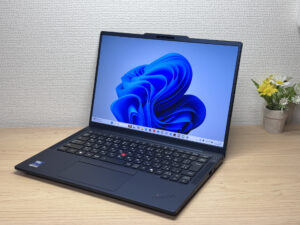
Let's start with the design. This blue is a colour you don't often see on ThinkPads, and honestly it felt like a genuinely fresh take. The matte finish also means fingerprints barely show, and while it keeps ThinkPad's traditional look intact, it comes across as sleek and grown-up.
 That fresh new blue finish on the front
 The ThinkPad logo giving off sharp corner styling
The lid looks properly smart in this blue too. The red dot on the ThinkPad logo only lights up when the laptop's powered on - a nice bit of playfulness you don't get on other laptops.
 The new blue really pops on the lid
 The ThinkPad logo glows red when powered on!
 The Lenovo logo on the side adds a subtle touch of class
Picking it up, it feels really thin, and being aimed at business users, it slots into a bag without any fuss. At around 1kg, combined with how slim it is, this puts it firmly in the top tier.
 Slim enough to slide straight into a bag
The underside is a bit different from what you'd expect - rather than vents spread across the whole base, it's all consolidated into one mesh panel for a single fan, which keeps things looking tidy. The rubber feet are solid too, so there's no worry about the laptop shifting around while you type.
 A neatly consolidated vent layout
Opening the lid is impressively smooth - you can hook a finger under the camera bump and flip it open one-handed without any trouble. It opens the full 180 degrees, true to ThinkPad tradition, which comes in handy when you want to show someone the screen across a table.
 A smooth hinge that opens with one hand
 It opens fully flat to 180 degrees
Portability
Next, let's look at how easy it is to carry around. Weighing it myself, it came in just over 1kg, and holding a laptop that light really does make a difference - it lowers the bar for taking it with you everywhere.
 Just over 1kg on the scales
The official charger weighed in at 260g, and honestly, that felt a bit bulky. That said, it charges over USB-C, so swapping it for a compact third-party USB-C charger (an Anker one, say) cuts down what you're carrying considerably. My suggestion: keep a small charger in your bag for everyday use and leave the official one at home or in the office.
 The official charger weighed in at 260g
 A small USB-C charger keeps your bag light
Picking it up one-handed, you barely notice the weight at all - it just lifts straight up. It's genuinely easy to move around the house or office with. Light really is right, and this reminded me of that.
 Light enough to lift easily with one hand
Display quality
Let's move on to the display. The unit we borrowed came with a 2880x1800, 120Hz OLED panel, and the colours are genuinely vivid. Photos of fruit and flowers came through looking fresh and lifelike, and the blacks felt properly deep too.
 Vivid colours that show off the OLED panel
 Fresh, lifelike colour reproduction on fruit
 Even colour-heavy fruit shots come through sharp
Viewing angles are wide too - even looking at it from a steep angle off to the side, the colours held up well.
 Colours hold up even from an angle
The 16:10 aspect ratio means you get more screen real estate than a 16:9 panel, so there's less scrolling and work goes more smoothly as a result. Wikipedia pages came through crisp and easy to read, and it feels well suited to coding work too.
 More usable screen space thanks to 16:10
 Code in VS Code is easy to read too
Reflections were minimal as well - being a non-glare panel, it rarely got that flickery, hard-to-see effect even under fluorescent lighting.
 Minimal reflections even under fluorescent lighting
Keyboard feel
Next up is the keyboard. Lenovo's a global brand, so key layouts often end up shared across regions, but this model has a properly thought-out layout, and there's barely any crowding between keys - that's a real plus.
 A tidy layout with well-spaced keys
I tried writing some code in VS Code to test the feel, and while the keycaps don't have quite the same soft touch as the Yoga range, it's a light, snappy typing experience with a good rhythm to it. The classic TrackPoint (the little red nub) is still here too, and if you're used to it, it's genuinely handy for working the cursor without a mouse in tight spaces - like on a train with the laptop on your knee.
Coding feels comfortable thanks to the light keystrokes
 Typing text flows smoothly too
There's a backlight as well, and it lights things up well enough in the dark that you shouldn't have any trouble working.
 A backlight that's easy to see in low light
Quick heads-up: these photos are the Japan-market unit, so the keyboard shown is the Japanese layout. UK models ship with the standard UK (ISO) layout.
Trackpad usability
Let's look at how usable the trackpad is. There's a good-sized trackpad beneath the keyboard, and the physical left-click, right-click and centre-scroll buttons that ThinkPad's known for are still here. Personally, I reckon you could do without the physical buttons since the trackpad itself handles clicks fine, but a lot of TrackPoint fans use them together, so it's a welcome touch for anyone who falls into that camp.
 A large, smooth-gliding trackpad
It glides nicely, and gestures feel properly responsive - it felt close to using a MacBook.
 Gestures feel close to a MacBook
Performance
Now let's check the processing power. This configuration runs an Intel Core Ultra 7 356H, and it scored 7689 on PCMark 10. Everyday tasks are handled with zero issues - if anything, it feels genuinely snappy.
 A strong score on PCMark 10!
| Total Score | Rating | What it feels like in real use |
|---|---|---|
| ~4,000 | Bare minimum | Web browsing and simple tasks work, but multitasking or many tabs feels sluggish. |
| 4,000–5,000 | Light use | Daily tasks are doable, but running multiple apps means waiting around. |
| 5,000–6,500 | Comfortable (mainstream) | Handles most work without stress — fine for office, school, video calls. |
| 6,500–8,000 | High performance This PC | Plenty of headroom. Light photo editing and programming feel snappy. |
| 8,000+ | Very high performance | Tackles video editing and heavy workloads. Long-lasting performance. |
*PCMark 10 reflects overall comfort. Actual feel depends on CPU, RAM, and SSD speed.
The Cinebench multi-core score came in at a solid 3291, giving it plenty of muscle for heavier tasks like video editing.
 Strong multi-core performance too
| Score | Rating | What it feels like in real use |
|---|---|---|
| Up to 1,000 | Bare minimum | Light tasks work, but heavier processing or multitasking feels constrained. |
| 1,000–2,000 | Standard (power-efficient) | Handles daily tasks, but heavier loads create waiting. |
| 2,000–3,000 | Comfortable (mainstream) | Office, school, video calls all work comfortably. Plenty for most users. |
| 3,000–4,000 | High performance This PC | Comfortable for multitasking, light/medium editing, and dev work. |
| 4,000+ | Very high performance | Handles video editing and heavy workloads with room to spare. |
*Cinebench 2026 is the latest CPU multi-core benchmark. Scores trend lower than R23, so direct comparison isn't valid.
GPU performance landed at 2183 on Steel Nomad Light, enough for lighter PC games. Not that many people are buying this for gaming, but it should come in handy for things like video rendering.
 A solid score for an integrated GPU
| Score | Rating | What it feels like in real use |
|---|---|---|
| Up to 400 | Bare minimum | 3D performance is quite limited. Not really suited for gaming. |
| 400–900 | Light 3D | Lighter games and low-load 3D processing work. |
| 900–1,500 | Average (mainstream) | Standard for integrated GPUs. Light to medium games playable with right settings. |
| 1,500–2,200 | High performance This PC | Strong for an integrated GPU. Games and 3D work feel comfortable. |
| 2,200+ | Very high performance | Top-tier 3D performance for thin laptops. Real graphics headroom. |
*3DMark Steel Nomad Light targets thin laptops and integrated GPUs. Score range differs from Time Spy, so direct comparison isn't valid.
Storage speed impressed too, with 7008.42MB/s read and 5787.10MB/s write - genuinely fast. That should keep things moving smoothly if your work involves shifting large files around.
 Blazing-fast storage with next to no waiting around
| Score | Rating | What it feels like in real use |
|---|---|---|
| Up to 600 MB/s | Bare minimum | Faster than HDD, but slow for modern SSDs. App launches feel slightly slow. |
| 600–1,500 MB/s | Average | Fine for daily use, though loading is noticeably slower than top-tier SSDs. |
| 1,500–3,500 MB/s | Comfortable (mainstream) | App launches and file loading feel smooth. No real complaints in daily use. |
| 3,500–5,500 MB/s | Fast | Loads large data and apps quickly. Definitely upper-tier SSD speed. |
| 5,500+ MB/s | Very fast This PC | High-end NVMe territory. Heavy data work without waiting. |
*CrystalDiskMark measures SSD speed. It mainly affects app launch and file loading speed, not overall PC performance.
Battery life
Battery rating: average
It's running a 58Wh battery, which is fairly standard for a laptop these days. That said, this configuration has an OLED panel and a 120Hz refresh rate, both of which draw more power, so I wouldn't take the manufacturer's quoted 19.6 hours at face value. Push the brightness and refresh rate up and getting through a full day without a charger could be a bit of a stretch.
 Checking the battery health
If you're regularly working away from a plug for long stretches, it's worth keeping a power bank or USB-C charger on hand.
Fan noise and heat
Let's check the fan noise and heat, since that's always a concern. When you're not doing much, it's practically silent, and the measured idle noise was low too.
 Practically silent at idle
| Noise Level | Rating | Feel |
|---|---|---|
| Under 30 dB | Near-silent | Fan noise is barely perceptible — library-quiet and ideal for focused work. |
| 30–35 dB | Quiet Idle | Faintly audible but non-distracting. Easy to work in a quiet room. |
| 35–40 dB | Noticeable Load | You can tell the fan is spinning, but it rarely interrupts work. |
| 40–45 dB | Somewhat loud | Can become distracting in quiet environments. Headphones start to help. |
| 45–50 dB | Loud | Noticeable stress over extended use. Cooling is clearly prioritized. |
| 50 dB+ | Very loud | Prominent fan noise under load — gaming/high-performance thermal design. |
Even under load, it rarely crept above 40dB, and keeping fan noise this low in such a thin chassis is genuinely impressive.
 Stays quiet even under heavy load
The exhaust vent sits on the underside, so hot air doesn't blow directly onto your hands. That means no uncomfortable warmth while you're using the mouse.
 Rear exhaust keeps your hands comfortable
Ports and connectivity
Let's check out the ports too. On the left side you'll find HDMI, USB-C (with Power Delivery), and a headphone jack, so wired earphones work fine without any extra adapter.
 HDMI and USB-C on the left side
On the right, there's a Kensington lock slot, USB-C and USB-A, giving you enough expandability to hook up all sorts of peripherals from this one laptop. Exactly what you'd expect from a business laptop.
 USB-A and Kensington lock support on the right
I plugged it into an external monitor over HDMI, and it came through without a hitch.
 A single HDMI output worked perfectly
Using both USB-C ports, I could even drive two 4K monitors at once, so if you're at home or in the office, setting it up with external monitors as a desktop replacement is well worth doing. Working across multiple screens makes a real difference compared with just the laptop display.
 Two 4K monitors over the two USB-C ports
A USB-C hub gives you even more ports if you need to expand further, so it's worth pairing one with this if you want extra flexibility.
 Add a hub for even more expandability
Webcam
Let's look at how useful the webcam is. It's a 5-megapixel built-in camera, and the picture quality on video calls is genuinely good. Getting a camera with this much resolution at this price point is honestly quite rare.
 A bright, clear picture from the built-in camera
There's a privacy shutter too, so you can cover the lens in seconds. No need to fiddle with software to turn the camera off, which is handy if you need to cover it up in a hurry.
 A physical shutter for quick peace of mind
Speaker quality
Let's check the speaker quality too. I put a film on to test it, and the volume that came out of such a thin chassis genuinely surprised me. Clear sound with proper bass behind it - you'd barely need external speakers to watch a video on this alone.
 Films sound properly punchy on this
 Sound comes through from speakers on either side
Security features
Let's cover the security features too. It supports both face and fingerprint recognition, so if you're wearing a mask and face unlock isn't practical, you can switch straight to fingerprint just by touching the power button.
 Face unlock works smoothly
 Fingerprint unlock is handy when wearing a mask
Price
A word on price. The configuration we borrowed - 32GB of memory and a Core Ultra 7 356H - sits near the top of this model's range, and with the OLED panel on top, it pushes the price up accordingly. That said, the cheapest model starts with a Full HD panel, 16GB of memory and a Core Ultra 5 325, and still comes with a fingerprint sensor as standard, so if you want to keep costs down, that's well worth a look.
Verdict
Honestly, this comes across as a genuinely easy-to-live-with business laptop, combining light weight, solid build quality, and the peace of mind of both face and fingerprint recognition. The higher-end OLED configuration does dent the value proposition a bit, but even so, the light weight, generous ports and speaker quality are strong selling points. I'd say this is a great fit for business folks who've grown used to the ThinkPad TrackPoint, or anyone who puts security high on their list.
A laptop that'll really click with anyone used to the classic ThinkPad TrackPoint
Where to Buy
* Prices may vary. Please check each store for the latest price and availability.
Where this laptop ranks

About the author